
How Warrants Are Issued in Menominee County
Most warrants in the county trace back to a single moment described on the 95A District Court criminal page. When someone is accused of a crime, the government, represented by the Prosecuting Attorney, begins the case by filing a complaint against the defendant. If the defendant has not already been arrested, a warrant for arrest is issued when that complaint is filed. Judges and magistrates in the 95A District Court and the 41st Circuit Court also issue warrants directly, most often a bench warrant when a person misses a required court date or violates a condition of release. The Prosecuting Attorney reviews, authorizes, and prosecutes felony and misdemeanor violations, so the charge behind a warrant usually starts in that office.
There is no official Menominee County online active-warrant list on the Sheriff, District Court, or Circuit Court pages. A warrant instead shows up as an event on the case it belongs to, appearing in the register of actions as an entry such as warrant issued, failure to appear, bench warrant, or show cause. Because the record updates only when the court or clerk enters the next event, custody status can change before a case screen reflects it. Treat any online clue as a starting point and confirm a live warrant directly with the issuing court or the Sheriff's Office.
Types of Warrants in Menominee County
Warrants are not all the same, and the type controls which office to call and how to clear it. The categories below cover what commonly appears in Menominee County District and Circuit Court records.
- Arrest warrant - Issued when the prosecutor files a complaint and the accused has not been arrested, authorizing law enforcement to take the person into custody.
- Bench warrant - Ordered by a judge or magistrate, usually after a missed hearing, an unpaid obligation, or a violated court condition.
- Failure-to-appear / capias - A form of bench warrant triggered when a defendant does not answer a citation, summons, or scheduled date, common in traffic and misdemeanor matters.
- Probation violation or show-cause warrant - Issued when a person allegedly breaks probation terms or ignores a court order, often routed through Circuit Court.
- Search warrant - Authorizes officers to search a place or item; these are frequently nonpublic before they are executed and returned to the court.
How to Check for a Menominee County Warrant
Because there is no public database to type a name into, checking for a warrant means working a short fallback chain by phone and case search. Start with the court most likely to hold the matter, confirm custody with the jail, and use the statewide case system only for docket clues. The steps below put that order into practice.
- Call the 95A District Court clerk at 906-863-8532 for bench warrants, failure-to-appear defaults, and adult criminal complaints, or the Magistrate at 906-863-6776 for traffic and civil-infraction defaults.
- Call the County Clerk and 41st Circuit Court at 906-863-9968 for felony cases after bindover, circuit bench warrants, probation and sentencing warrants, and PPO or contempt matters.
- Call the Menominee County Jail at 906-863-4441 to confirm whether a person is currently held locally or has already been booked.
- Search the underlying case by name or case number on MiCOURT for public docket entries that hint at a warrant, then verify the result with the court before acting on it.
- Contact the Prosecuting Attorney at 906-863-2002 if the question is whether charges have been authorized rather than whether a warrant has issued.
The Sheriff's Office runs civil process and 24-hour jail service from the same 10th Avenue block as the courthouse, so a custody question and a court question are rarely far apart. You can review the office and its civil-process contact on the Menominee County Sheriff civil process page.
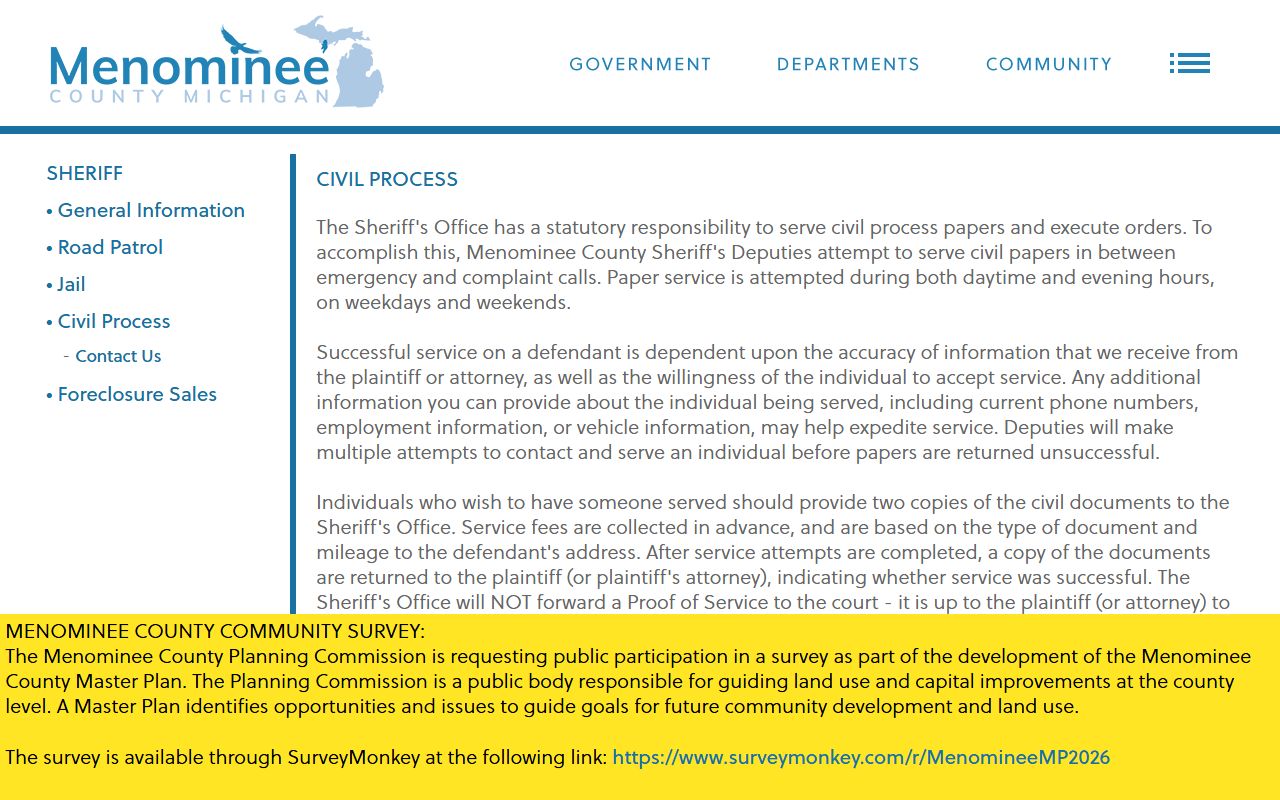
Seeing the Sheriff's own page makes the split clear: the office can tell you about custody and service of process, but the court that issued the paper is the office that can explain or clear a Menominee County warrant.
Where to Check for a Menominee County Warrant
Since a name search has no single portal, the practical search field is the phone directory of offices that touch a warrant. Match the matter to the office in the routing table below, then call with the person's full name, date of birth if known, and any case or citation number.
| Where to Check | What It Covers | Contact |
|---|---|---|
| 95A District Court Clerk | Bench warrants, failure-to-appear, adult criminal complaints, bond, arraignment | 906-863-8532 |
| District Court Magistrate | Traffic and civil-infraction defaults and warrants | 906-863-6776 |
| County Clerk / 41st Circuit Court | Felony cases after bindover, circuit bench warrants, probation and PPO matters | 906-863-9968 |
| Sheriff's Office / Jail | Arrest and custody status, whether a person is held locally | 906-863-4441 |
| Prosecuting Attorney | Charge authorization and whether a complaint has been filed | 906-863-2002 |
| MiCOURT Case Search | Public docket entries that hint at a warrant on an existing case | micourt.courts.michigan.gov |
Searchers who use MiCOURT should treat it as a clue tool rather than a warrant clearance tool. The screen at the MiCOURT case search portal can show a warrant or failure-to-appear entry on a participating court's docket, but it does not confirm in real time whether officers still hold the warrant.
Some people running a warrant question also verify related statewide records at the same time, such as the registry the state maintains separately from any court file. The Michigan State Police sex offender registry is a different record set from a warrant, and the state site helps show where those checks live.
Keeping the two apart avoids a common mistake: a registry hit is not a warrant, and a warrant is not a registry entry, so a full Menominee County warrant check still returns to the issuing court.
What a Menominee County Warrant Record Shows
When warrant details are visible in a court or jail record, they follow a predictable set of fields. The exact display depends on the court, the case type, and whether the warrant has been served, but the inventory below reflects what appears in Michigan District and Circuit Court records.
| Field | What It Shows |
|---|---|
| Defendant Name and DOB | Person named in the warrant, with date of birth or age where public |
| Case Number | The underlying case the warrant belongs to |
| Issuing Court | 95A District Court or 41st Circuit Court |
| Warrant Type | Arrest, bench, failure to appear, probation violation, show cause, or search |
| Charge or Case Type | The offense or underlying matter driving the warrant |
| Bond Amount and Type | Bond set for release, if any |
| Issued Date | When the court or complaint produced the warrant |
| Served / Returned / Cleared Date | Whether the warrant has been executed or resolved |
| Next Hearing | Arraignment or hearing date once the person is before the court |
| Arresting Agency / Custody Status | Agency and jail status if the person has been booked |
Charges may not appear on the jail side until after a complaint and arraignment, so a felony or misdemeanor tied to a warrant is often clearer in the case file than in a custody screen. The full charge history and disposition live in the Menominee County criminal court records for the case.
What to Do If You Have an Outstanding Warrant
Ignoring a warrant only adds cost and risk, and in traffic matters it can compound quickly. The Civil Infraction page warns that failing to respond can lead to a default judgment, and after more than 28 days a license may already be suspended with added costs. The better path is to identify the issuing court from your notices, call the 95A District Court for district criminal, traffic, or misdemeanor defaults, or the County Clerk and 41st Circuit Court for felony and circuit matters, and ask specific questions. Find out whether a bond is set, whether a voluntary appearance can be scheduled, whether a payment will clear a default or a hearing is required, and whether AllPaid can accept the relevant bond or payment.
If you are arrested on the warrant, expect jail booking, an arraignment and bond review, and possible VINE notification to any victims. Custody status after that point is easier to track through the Menominee County inmate records and the jail directly. Every step goes more smoothly when you understand the charge before you appear.
Important: Speak with a defense attorney before you turn yourself in or resolve a warrant. The court cannot give legal advice, and a lawyer can protect your rights on bond and appearance.
Reporting a Tip to the Sheriff's Office
Official Menominee County pages do not list a dedicated Crime Stoppers phone line or a separate anonymous-tip reward program, so there is no such number to publish here. A resident who wants to report information relevant to a wanted person or an open case can contact the Menominee County Sheriff's Office directly, since the office runs road patrol and jail services 24 hours a day, seven days a week. The Sheriff's Office and its report-request paths are described on the Menominee County Sheriff page. For emergencies or a crime in progress, call 911 rather than a records line.
Restricted Menominee County Warrant Records
Not every warrant is open to the public, and the limits exist for safety and fairness. Juvenile warrants and case files are restricted under Michigan law and generally are not visible in a public search. Sealed or nonpublic matters follow the court-record access rules and may not appear at all. Search warrants are commonly withheld before they are executed, since disclosing them in advance would defeat their purpose, and they become part of the public file only after they are served and returned to the court. When a record is restricted, the court office decides whether a court order, party status, attorney appearance, or legitimate-interest showing is required.
Federal warrants sit in an entirely separate system. Menominee County is in Michigan's Western District, so a federal charge would be handled by federal offices rather than the county. Details on federal prosecution live with the U.S. Attorney's Office for the Western District of Michigan, and fugitive and warrant enforcement runs through the U.S. Marshals Service Western District of Michigan.
Reviewing the U.S. Attorney site shows why a federal matter never appears on a county warrant check: the charging authority, the docket, and the enforcement chain all sit outside Menominee County.
For federal court dockets and published opinions that may reveal how a related case is proceeding, some researchers turn to a public legal-records archive. The dockets and opinions collected at CourtListener can add context to a federal matter, though a live warrant is still confirmed through the court or the Marshals Service.
Between the county courts, the Sheriff's Office, and these federal channels, a complete Menominee County warrant check always ends with a phone call to the office that issued or holds the warrant.