
Menominee County Arrest Records and Court Charges
A Menominee County arrest record documents the arrest itself: who was taken into custody, the arresting agency, and the booking that follows at the county jail. It is a law enforcement record on the sheriff and jail side of the system. The court charge record is a different file that begins when the prosecuting attorney reviews the case, authorizes charges, and files them with the court. In Michigan the prosecutor, not the arresting officer, decides the formal charges, and the District Court criminal process confirms that a case begins when the government files a complaint against a defendant. If the person has not already been arrested, an arrest warrant issues when that complaint is filed.
Keeping the two records straight matters because they live in different places. The booking and custody side, including who is currently held, is a sheriff function, and the county's jail roster and booking detail belong to the inmate records path rather than to the court. The court charges after arrest, along with their status as the case proceeds, sit in the court file. The complete case file, with the plea, disposition, and sentence, is covered under Menominee County criminal court records. This page focuses on the arrest-to-charges pathway and the charge record that ties them together.
How to Find Menominee County Arrest Records and Charges
The court charge record is searched through MiCOURT Case Search, the statewide portal where participating Michigan trial courts publish case history. Charges and charge status appear in the register of action, though document images stay off the public internet under Michigan court rules. Arrest and booking detail is not part of that court portal; for current custody status the county directs the public to phone the jail or use the statewide VINE notification service, and those custody paths are covered on the inmate records page.
- Open MiCOURT Case Search and select the trial court that fits the matter, remembering that all adult cases start in the 95A District Court.
- Search by the defendant's name or by the exact case number taken from a citation, complaint, or notice.
- Open the matching case and read the charge list, including each count and the statute cited.
- Check every charge's code, offense level, and current status, since charges can change after they are first filed.
Charges roll up into statewide systems as a case advances. The Michigan State Police criminal history channel and sex offender registry, along with the Department of Corrections OTIS tool for people sentenced to prison, probation, or parole, gather convictions from across the state and complement the county case file.
How Charges Get Filed After a Menominee County Arrest
The charge record begins when a charging document is filed, and the type of document depends on the offense and the court. After an arrest or a law enforcement referral, the Menominee County Prosecuting Attorney, Jeffrey T. Rogg, reviews the case and decides whether to authorize charges. In Michigan a misdemeanor or lower-level case is charged by a complaint in the District Court, a felony is carried forward on an Information filed in the Circuit Court after bindover, and a federal case is charged by a grand jury indictment. The table below shows what each document is and which court it belongs to.
| Complaint | Information | Indictment | |
|---|---|---|---|
| What It Is | The sworn charging document that opens a criminal case | The felony charging document filed after a preliminary examination | A charge returned by a grand jury in a federal case |
| Filed By | Prosecuting Attorney | Prosecuting Attorney | Federal grand jury |
| Court | 95A District Court | 41st Circuit Court | U.S. District Court |
| Common For | Misdemeanors and the start of felonies | Felonies bound over from District Court | Serious federal offenses |
The county's District Court pages describe how a case is filed and moves through the court after charges are authorized.
The 95A District Court case process page shows how the court opens and tracks a filed case.
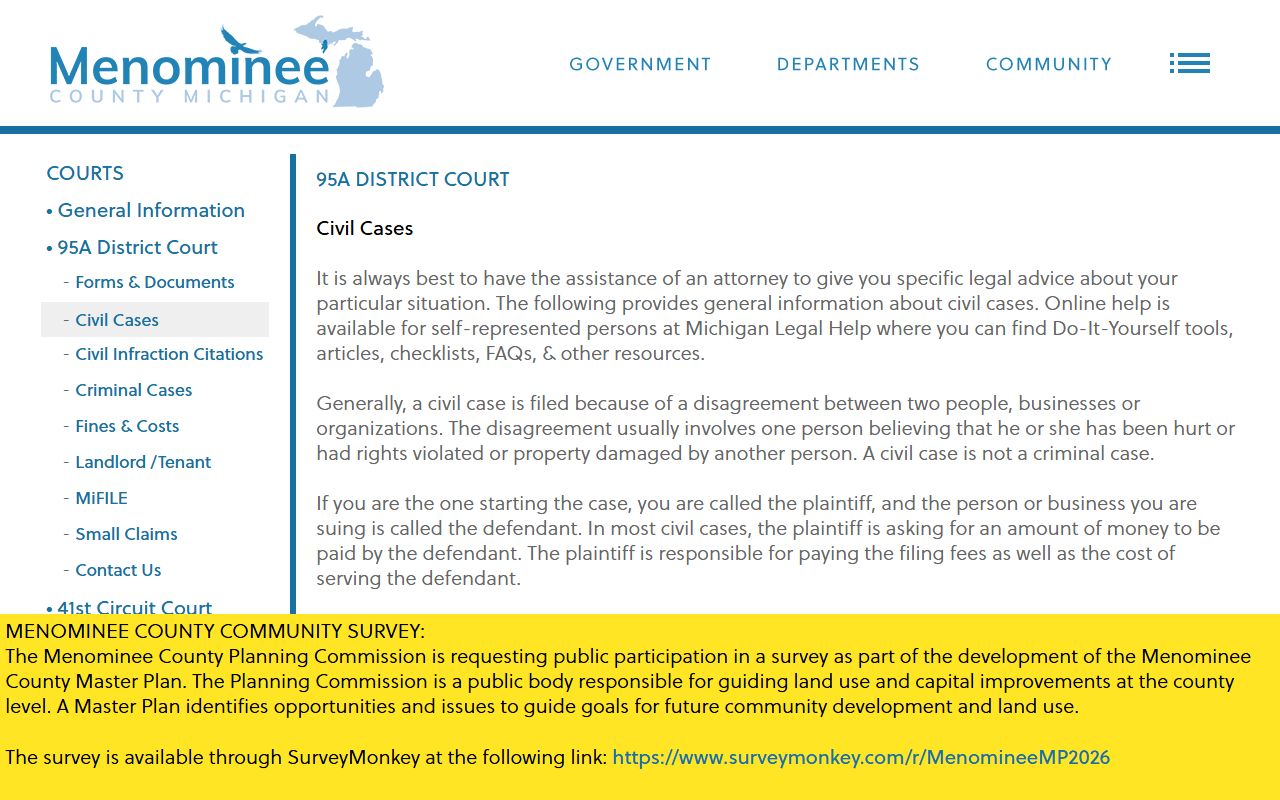
Because the District Court is where every adult case starts, a Menominee County arrest records search for the charges filed after booking usually begins with the District complaint before any bindover to Circuit Court.
Who Files the Charges After a Menominee County Arrest
An arrest does not set the charges. In Michigan that decision belongs to the elected Prosecuting Attorney, who serves as the chief law enforcement official in the county and reviews, authorizes, and prosecutes felony and misdemeanor violations. The office works with the Menominee County Sheriff's Department, the City of Menominee Police Department, the Hannahville Tribal Police Department, the Michigan State Police, and the DNR, and it represents the state in criminal matters before both the District and Circuit Courts. This is why the charge on an arrest record can differ from the charge that ends up in the court file: the prosecutor may add, reduce, or decline counts based on the evidence.
The office that authorizes charges publishes its role and duties for the public.
The Menominee County Prosecuting Attorney page describes how the office reviews and files criminal charges.
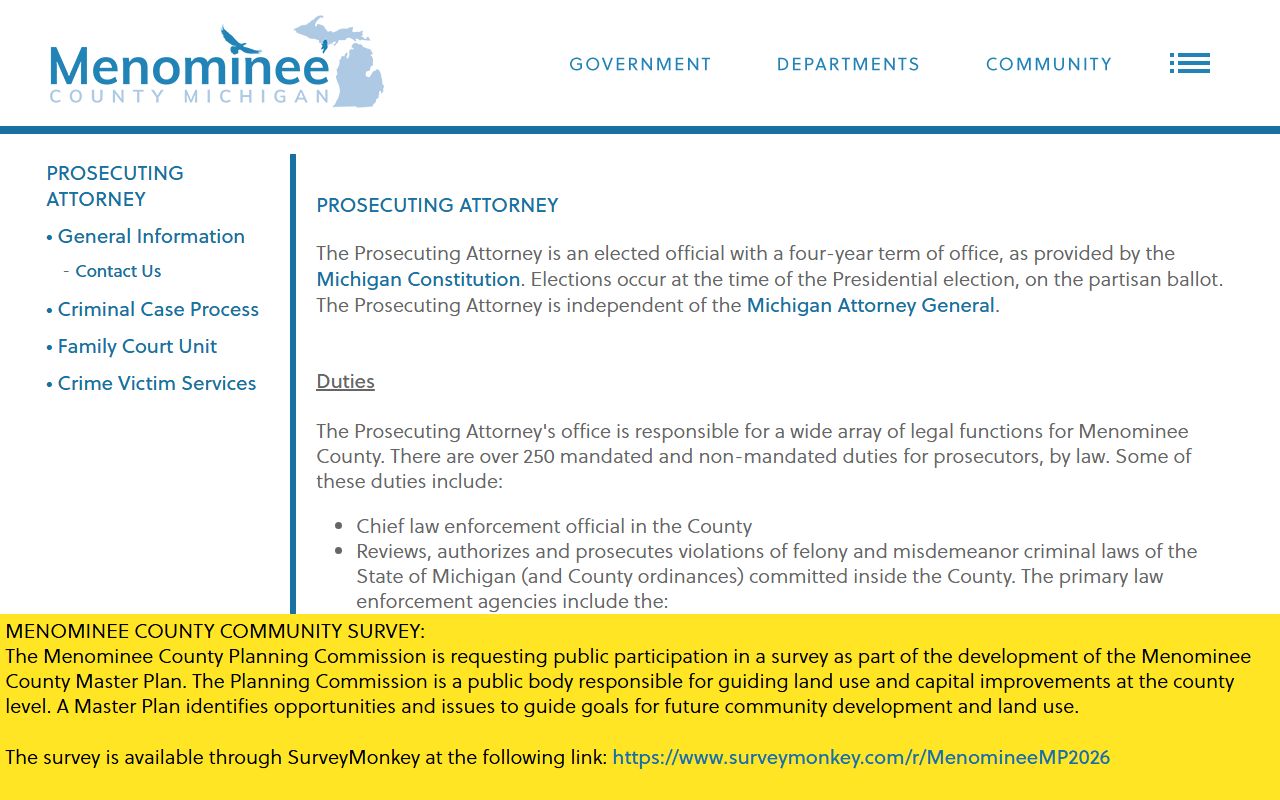
Reading the prosecutor's role clarifies why a Menominee County arrest records entry and the filed court charge are two decisions made by two different parts of the system.
Menominee County Charge Status and What It Means
Charges are not fixed once they are filed. As a case moves, a count can be amended, reduced, added, dropped, or dismissed, and the register of action records each change with a status. Following the status is how a reader tells a pending accusation from one that has already been resolved. The terms below appear most often in a Michigan charge record.
| Status | What It Means |
|---|---|
| Pending | The charge is filed and the case is still active, with no final outcome yet |
| Amended / Reduced | The charge was changed, often to a lesser offense, as the case developed |
| Dropped | The prosecutor chose not to pursue a count that had been filed |
| Dismissed | The court ended the charge, with prejudice if it cannot be refiled or without prejudice if it can |
| Nolle Prosequi | A formal entry that the prosecutor will not proceed on the charge |
Charge vs. Conviction
A charge is an accusation, not proof of guilt. Being charged after an arrest means only that a prosecutor believes there is enough to proceed, while a conviction requires a plea or a verdict proven beyond a reasonable doubt. A charge record can show counts that were later reduced, dropped, or dismissed, so a filed charge should never be read as a conviction. The comparison below keeps the two apart.
| Charge | Conviction | |
|---|---|---|
| Stage | Accusation filed by the prosecutor | Result of a plea or verdict |
| Burden of Proof | Probable cause to proceed | Proof beyond a reasonable doubt |
| Can Change | May be amended, reduced, or dismissed | Fixed unless appealed or set aside |
| Public Record | Yes | Yes |
Menominee County Charge Codes and Severity Levels
Every charge in a court record ties back to a specific statute, and that citation sets the offense level. Michigan sorts criminal offenses into felonies, which carry possible incarceration of more than a year and are tried in Circuit Court after bindover, and misdemeanors, which are punishable by a fine or up to a year and are handled in District Court. Civil infractions, such as most traffic violations, are not crimes at all and follow a separate District Court track. One arrest can produce several separate charges at once, each with its own statute, level, and status, which is why a single case can list multiple counts that resolve in different ways.
Statewide Charge and Criminal History Lookups
County case files are only part of the picture, because charges that end in conviction roll up into statewide records. Michigan maintains several public channels: MiCOURT Case Search for trial court case history, the Michigan State Police sex offender registry, and the Department of Corrections OTIS tool for people sentenced to state prison, probation, or parole. The state's open-records framework backs public access to government records generally, though court-case access is usually governed by the court rules rather than the Freedom of Information Act.
The statewide open-records statute and the Attorney General's plain-language guidance explain the public's right of access.
The Michigan Freedom of Information Act, Act 442 of 1976, sets the general right of access to public-body records.
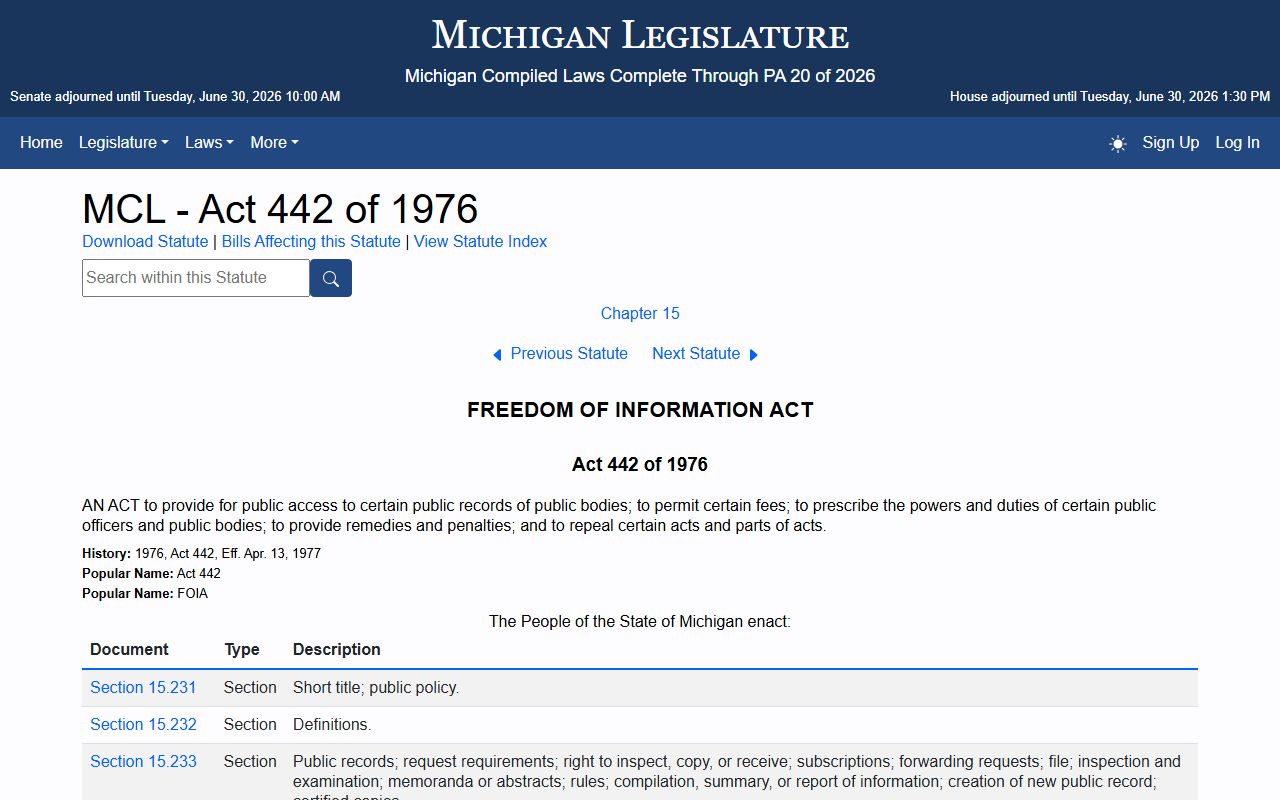
The FOIA statute covers public-body records broadly, but a Menominee County arrest records or charge lookup still runs mainly through the courts and the sheriff, each under its own access rules.
The state also publishes a reader-friendly summary of how the law works.
The Michigan Attorney General FOIA page explains in plain language how the public accesses records of public bodies.
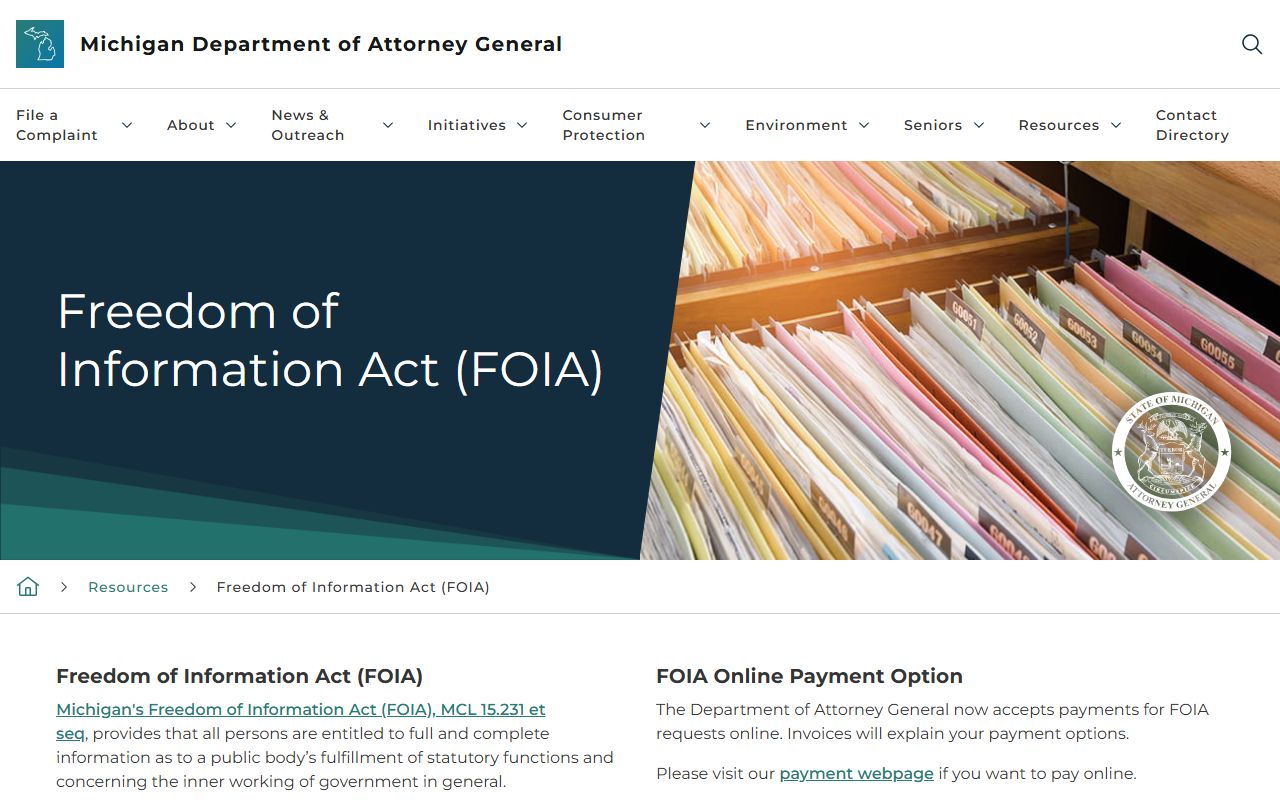
Reading the Attorney General's summary helps set expectations before a Menominee County arrest records request, since some law enforcement material is limited even when the case itself is public.
Background Check Considerations
Looking up a charge in a public portal is not the same as running a background check. A formal check used for employment, housing, or licensing must follow the federal Fair Credit Reporting Act and Michigan law, and it draws verified records from official sources rather than a quick name search. A public charge record is useful for confirming that a case exists and reading its status, but it is not a certified criminal history and should not be relied on as one.
Important: This site is not a consumer reporting agency under the Fair Credit Reporting Act, and its information may not be used for employment, tenant, credit, or other FCRA-regulated screening.
Restricted Charge Records in Menominee County
Not every charge is open to a public search. Juvenile charges handled by the Family Court are confidential, and under MCL 712A.28 juvenile court records are open only through a court order or a legitimate interest channel, so a public lookup should not be expected to show them. Charges tied to convictions that were later set aside under the state process lose their public status, and dismissed charges may be limited or withheld in some views. Ongoing investigations and sealed matters are also kept back. The statute that limits juvenile record access is worth reviewing before assuming a young person's charge will appear.
The juvenile record limits are set by state law.
MCL 712A.28 states that juvenile court records are open only by court order or through legitimate interest access.
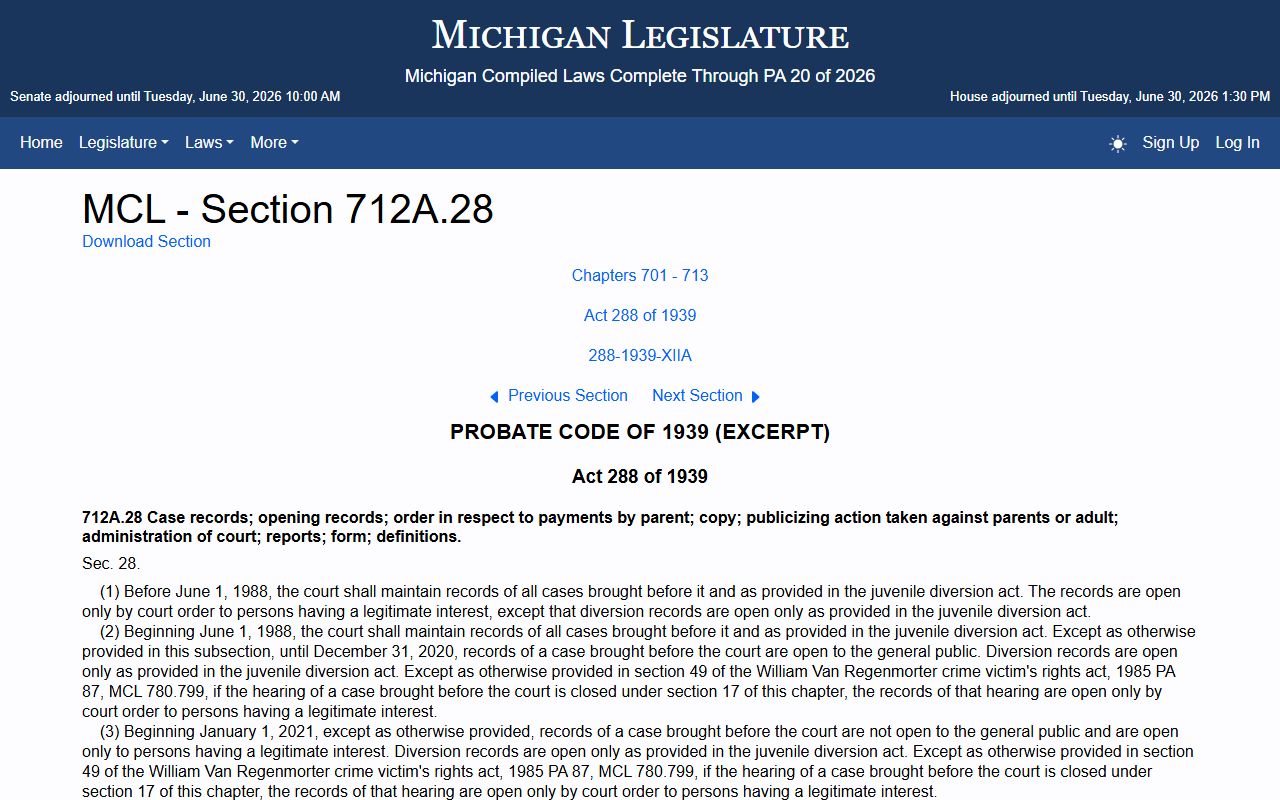
Because MCL 712A.28 closes juvenile files to the general public, a Menominee County arrest records search on a minor typically returns nothing, and lawful access has to be arranged through the court.