
Criminal Court Records in Menominee County
A criminal court record is the case file a court opens once formal charges are filed against a defendant. It is the complete, running account of the prosecution: the charging document, the defendant and prosecutor, each hearing and motion, the plea or verdict, and the sentence. In Michigan the clerk of the court that handles the case maintains that file, and the register of action inside it lists every event in date order. For felony matters the County Clerk serves as the filing clerk for the Circuit Court, while the District Court keeps its own criminal file for the early stages and for misdemeanors. That is why one person's case can leave records in two different courts.
Menominee County criminal cases move through Michigan's trial courts by severity. Every adult criminal case, misdemeanor or felony, begins in the 95A District Court, which handles the complaint, the arrest warrant, arraignment, bail and bond, and the felony preliminary examination. Misdemeanors punishable by up to one year generally stay in District Court through plea, trial, and sentencing. Felonies begin there and, if the court finds probable cause at the preliminary examination, are bound over to the 41st Circuit Court, the general jurisdiction trial court that handles serious criminal matters carrying possible incarceration of a year or more. The charges themselves are covered in more depth in the Menominee County arrest records and court charges guide, while the wider set of case types sits under general court records.
How to Search Menominee County Criminal Court Records
The main public channel is MiCOURT Case Search, the statewide portal that gathers participating Michigan trial courts into one interface. Criminal case availability depends on the court, and the public view shows register of action and case history rather than document images, because Michigan court rules prohibit public internet access to the underlying filings. To pull a criminal file, work from the court level down and copy the exact case number when you find it.
- Open MiCOURT Case Search and select the trial court or court location that fits the case, keeping in mind that felonies may sit in both District and Circuit Court.
- Search by the defendant's full name or by the exact case number if you already have it from a notice, citation, or complaint.
- Narrow the results by court, case type, and a filing date range when a common name returns too many entries.
- Open the matching case and read the register of action to follow the charges, arraignment, motions, plea or verdict, and disposition.
- Request a certified copy or full document from the clerk of the court of record, since images are not downloadable from the public internet.
Statewide criminal history sits in separate systems. Michigan State Police maintains the public criminal history channel and the sex offender registry, and the Department of Corrections OTIS tool shows people sentenced to state prison, probation, or parole. Those roll up convictions from many counties, so use them alongside, not instead of, the county case file.
How a Criminal Case Moves Through Menominee County Courts
A criminal case is a sequence of stages, and each stage leaves its own mark in the record. Reading the file in order shows where a case currently sits and what has already happened. In Menominee County the path is well defined because the District Court publicly describes how a case begins, proceeds, and either resolves or binds over to Circuit Court.
Case flow: Complaint / Charges Filed › District Court Arraignment › Bond › Preliminary Examination › Bindover › Circuit Court Arraignment on the Information › Pretrial › Plea or Trial › Disposition › Sentencing
The District Court criminal cases page lays out this progression from complaint through sentencing for the public.
The county's own District Court criminal cases page walks through each step a defendant faces after charges are filed.
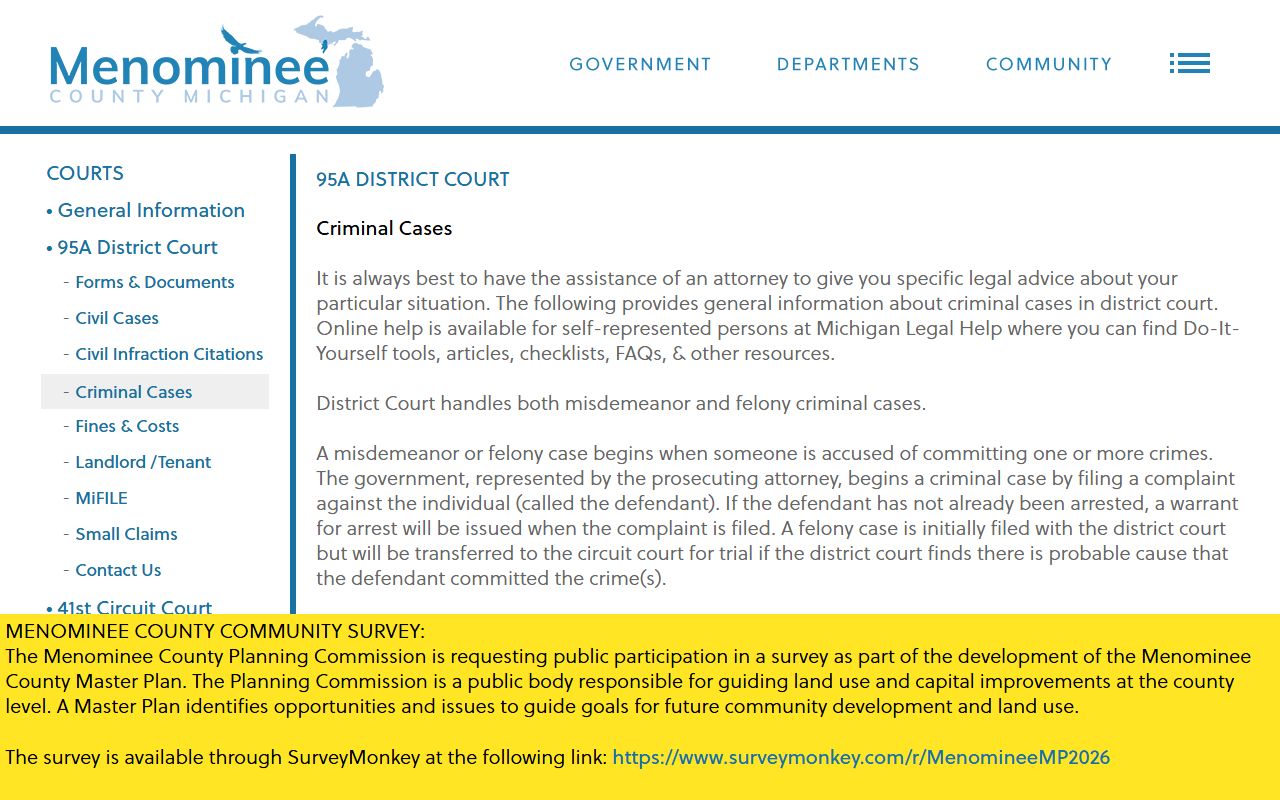
Because that page confirms every adult case starts in District Court, a Menominee County criminal court records search often needs both the District file for the early stages and the Circuit file once a felony is bound over.
| Stage | What Happens |
|---|---|
| Complaint and Warrant | The prosecuting attorney authorizes and files a complaint; if the defendant is not already arrested, an arrest warrant issues when the complaint is filed. |
| Arraignment | The judge or magistrate reads the charges, explains constitutional rights and possible penalties, and sets release conditions and bond. |
| Preliminary Examination | In a felony, the District Court holds a probable cause hearing, generally within 21 days of arraignment unless waived or adjourned. |
| Bindover | If probable cause is found, the felony transfers to the 41st Circuit Court for the trial-level stages. |
| Arraignment on the Information | In Circuit Court the defendant answers the Information, the felony charging document filed after bindover. |
| Pretrial and Motions | Both sides file motions, exchange discovery, and may negotiate a plea before trial. |
| Plea or Trial | The case resolves by plea or proceeds to a bench or jury trial that ends in a verdict. |
| Sentencing | After a conviction the court imposes a sentence, which may include jail or prison, probation, fines, costs, and restitution. |
What a Menominee County Criminal Court Record Shows
A criminal case file collects the facts that identify the defendant, define the accusation, and track the outcome. Some fields are set when the case opens, such as the case number and the charges, while others fill in as the case moves, such as the plea, disposition, and sentence. The public case view typically shows the identifying and procedural fields, while sensitive personal identifiers are redacted. The guide below summarizes the fields you can expect to read in a Menominee County criminal court record.
| Field | What It Shows |
|---|---|
| Case Number | Year, court or case type, and sequence used to pull the file in the correct court |
| Court and Venue | Whether the matter sits in the 95A District Court, the 41st Circuit Court, or both |
| Defendant | The accused person named in the case, with attorney of record where public |
| Charges | Each count, the statute cited, the offense description, and the offense level |
| Plea | The defendant's formal response, such as guilty, not guilty, or no contest |
| Docket Entries | Complaint, warrant, bond, preliminary exam, bindover, motions, hearings, and orders in date order |
| Disposition | How each charge ended: convicted, dismissed, acquitted, or otherwise resolved |
| Sentence | The penalty imposed, including custody, probation, fines, costs, and restitution |
Document images are usually not available from the public internet, so a searcher who needs the actual complaint, judgment, or sentence order requests it from the clerk of the court of record or reviews it at a courthouse public terminal.
Charges vs. Convictions
Reading a criminal court record correctly means separating an accusation from a proven outcome. A charge is what the prosecutor alleges; a conviction is what a plea or verdict establishes. A single file can list charges that were later dropped, dismissed, reduced, or that ended in an acquittal, and none of those results is a conviction. The comparison below sets out the difference so a record is not misread.
| Charge | Conviction | |
|---|---|---|
| Stage | Accusation filed by the prosecutor | Result of a plea or verdict |
| Burden of Proof | Probable cause to proceed | Proof beyond a reasonable doubt |
| Can Change | May be amended, reduced, or dismissed | Fixed unless appealed or set aside |
| Public Record | Yes | Yes |
Reading Dispositions and Sentences
The disposition is the final outcome recorded for a charge, and the sentence is the penalty that follows a conviction. Common disposition entries include guilty, not guilty, no contest, dismissed with prejudice, dismissed without prejudice, and bound over. A dismissal with prejudice ends a charge for good, while a dismissal without prejudice leaves room to refile. When a case ends in conviction, the sentence entry describes what the court ordered, and in Michigan that can combine jail time in the county facility or prison through the Department of Corrections, a term of probation, fines and court costs, and restitution to a victim. Reading the disposition and the sentence together, rather than either one alone, gives the accurate picture of how a case closed.
Sealed vs. Set Aside Records in Menominee County
Michigan does not use the word expungement in its statute. The state process is called setting aside a conviction, and it is separate from sealing. A sealed record is withheld from public view by court rule or order while the file still exists, while a set-aside limits public access to an eligible conviction so that, for most purposes, it is treated as if it never happened. The set-aside process runs under MCL 780.621 and related sections, with waiting periods defined by MCL 780.621d and special treatment for traffic offenses under MCL 780.621c. Some eligible convictions are set aside automatically under Michigan's Clean Slate provisions, while others still require an application filed in the court of conviction.
| Sealed | Set Aside (Expunged) | |
|---|---|---|
| Visibility | Withheld from public view while the file remains | Removed from public access; treated for most purposes as never occurring |
| Law Enforcement | Courts and police keep limited access | A nonpublic record may be retained for law enforcement and court use |
| Eligibility | Set by court rule or order for the specific case | Eligible convictions under MCL 780.621, subject to waiting periods |
The core Michigan set-aside statute is worth reading before assuming a conviction can be cleared.
The text of the adult conviction set-aside law appears at MCL 780.621, which governs applications to set aside eligible convictions.
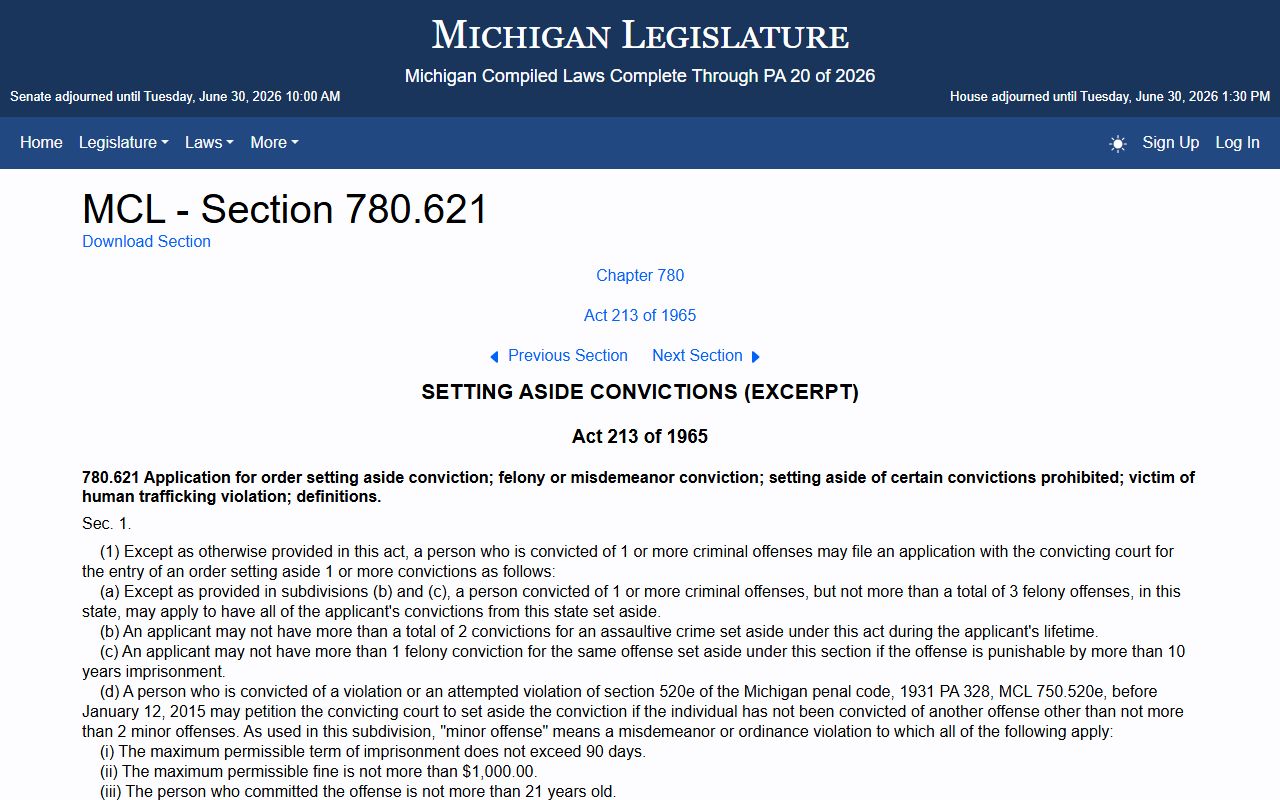
Because MCL 780.621 controls which convictions qualify, a Menominee County criminal court records set-aside starts with confirming the case number in the court of conviction, District or Circuit.
Traffic convictions follow their own set-aside rules.
The traffic offense provision is set out at MCL 780.621c, which treats traffic offenses differently from other convictions.
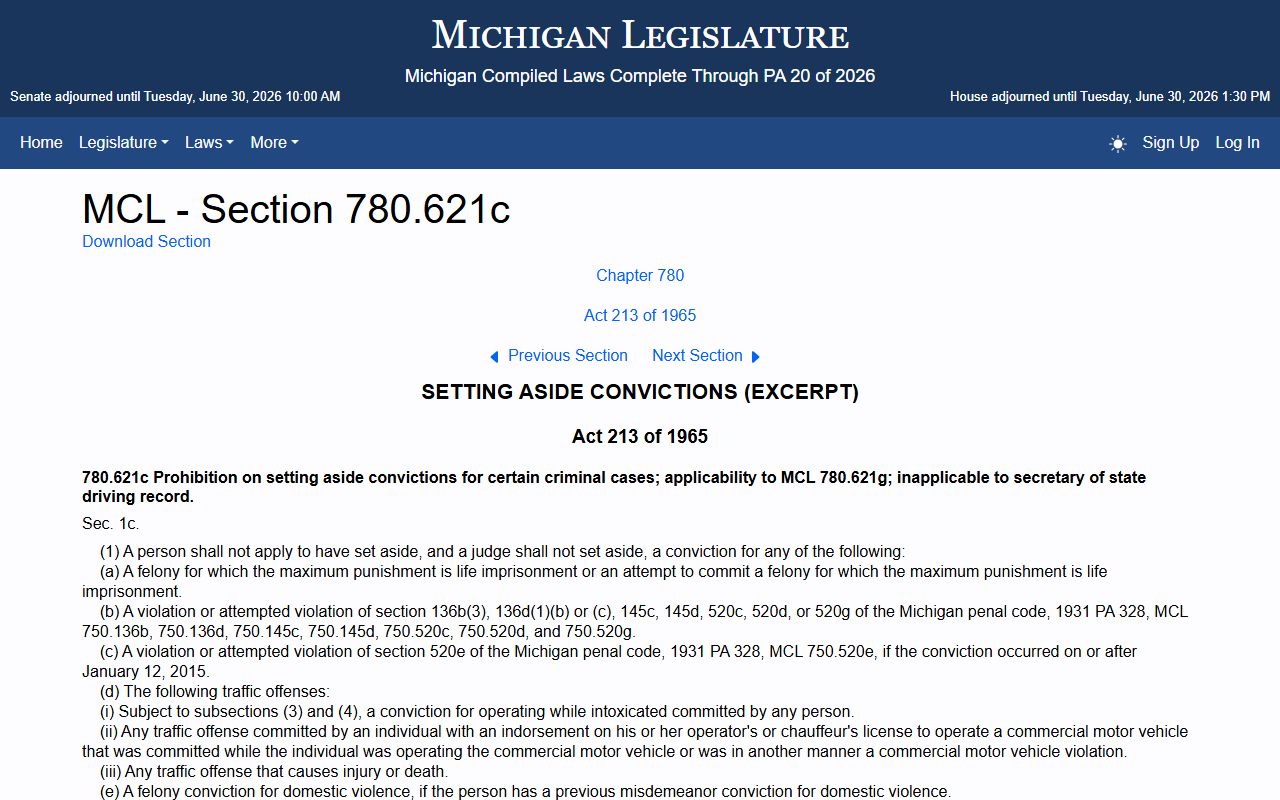
An order setting aside a traffic offense does not always remove the conviction from driver record consequences the way it clears the court file, so both sides should be checked.
Waiting periods decide when an application can even be filed.
Those timelines are defined at MCL 780.621d, which sets the waiting periods for setting aside eligible convictions.
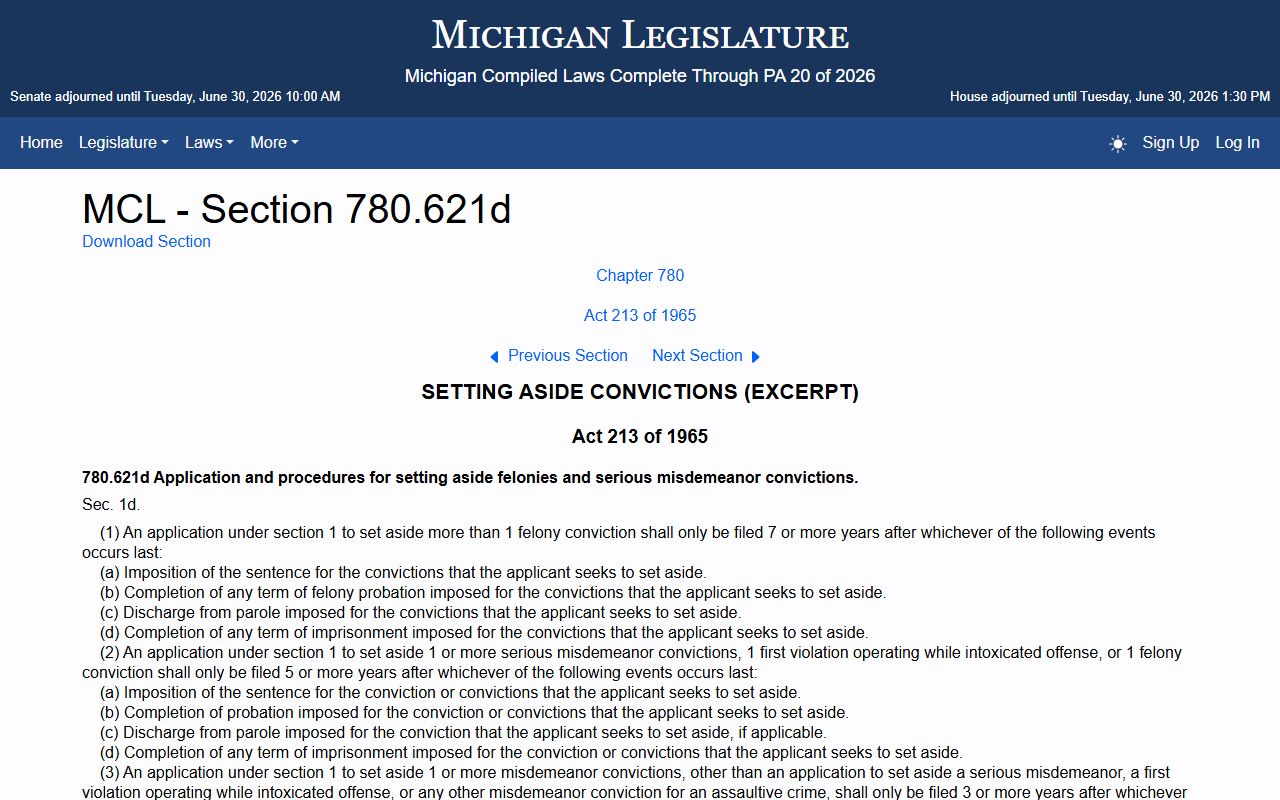
Reading MCL 780.621d before applying tells a person whether the required time has passed since a conviction or release, which is often the first thing a Menominee County criminal court records set-aside turns on.
Federal Criminal Court Records for Menominee County
Not every criminal case involving a Menominee County resident is a state case. Federal crimes are prosecuted in the U.S. District Court for the Western District of Michigan, which covers the county, and those files are entirely separate from the 95A District Court and 41st Circuit Court records. Federal dockets are accessed through the court's electronic filing system rather than MiCOURT, and access generally requires a PACER account with per-page fees unless an exemption applies.
The Western District's electronic access point is the place to confirm a federal criminal matter.
Federal filings for this district open through the Western District of Michigan CM/ECF system, the official docket source for federal cases.
If a Menominee County criminal court records search turns up nothing in the state system, the matter may be federal, and the CM/ECF or PACER channel is where that file would appear.
Public Access to Menominee County Criminal Court Records
Michigan treats most criminal case files as public, but the rules that control access come from the court rules more than from the Freedom of Information Act. Court records are defined and governed under the Michigan Court Rules, which set what the clerk must keep and how the public may inspect or copy it. The same rules bar the courts from posting document images to the public internet, which is why online searches show case history while the underlying filings stay at the courthouse or with the clerk.
Key Rules:
Michigan Court Rule 1.109 defines a court record as recorded information created by or filed with a court under the court rules.
Michigan Court Rule 8.119(H) bars public access to document images through the internet, so filings are obtained at the courthouse or from the clerk.
Background Check Considerations
A casual name lookup in a case portal is not the same as a formal background check. Employers, landlords, and licensing bodies that rely on criminal history for a decision must use a screening process that follows the federal Fair Credit Reporting Act and Michigan law, and that process pulls verified records from official sources rather than a quick public search. A public case view is useful for confirming that a case exists and reading how it ended, but it is not a certified criminal history and should not be treated as one.
Important: This site is not a consumer reporting agency under the Fair Credit Reporting Act, and its information may not be used for employment, tenant, credit, or other FCRA-regulated screening.
Restricted Criminal Court Records in Menominee County
Some criminal matters are not open to a general public search. Juvenile delinquency and child protective files handled by the Family Court are confidential, and under MCL 712A.28 juvenile court records are open only through a court order or a legitimate interest channel, so a public search should not be expected to show them. Convictions that have been set aside under the state process lose their public-facing status, and mental health commitment matters heard in Probate Court carry strong confidentiality. Sealed cases, redacted personal identifiers, and ongoing investigations round out what a public criminal search will not fully display. When a record does not appear, the correct step is to ask the court of record whether a court order, party status, or legitimate interest showing is required for lawful access.